

A complete guide to contractor websites, including the pages you need, SEO, mobile design, trust, and turning more visitors into leads.
The Complete Guide to Contractor Websites


THE SHORT ANSWER
A good contractor website should clearly show what you do, where you work, why homeowners should trust you, and how they can contact you. It should be fast, mobile-friendly, easy to navigate, and built to help the right homeowners find you, trust you, and contact you.
WEBSITES
What Should a Contractor Website Actually Do?
Before worrying about colors, animations, or fancy designs, your website needs to accomplish a few basic things.
A homeowner should be able to quickly understand:
-
What services you provide
-
Where you provide them
-
Why they should trust your company
-
How they can contact you
Your website should make it easier for potential customers to discover your business, learn about what you do, see examples of your work, and decide whether you're the right contractor for their project.
A beautiful website that confuses visitors or makes contacting you difficult isn't doing its job.
Clarity comes first.
Do Contractors Really Need a Website?
You can absolutely build a successful contracting business through referrals. Plenty of contractors have.
The problem is that referrals can only take you so far.
A website gives homeowners another way to discover your company and just as importantly, it gives people who already heard about you somewhere to check you out before calling.
Think about what you do when someone recommends a company to you.
There's a good chance you Google them.
Homeowners do the same thing.
They want to see your work, read reviews, understand your services, learn where you operate, and make sure your business looks legitimate before inviting you to their property or spending thousands of dollars with you.
So even when a referral originally introduces someone to your company, your online presence can still influence whether that referral becomes a customer.
What Pages Does a Contractor Website Need?
There's no magic number of pages every contractor website needs.
A five-person landscaping company and a multi-location HVAC company shouldn't necessarily have the same website.
But most contractor websites should have a few core pages.
Homepage
Give visitors an overview of your company, primary services, service area, work, reputation, and how to contact you.
About
Tell people who they're potentially hiring. Explain your story, experience, team, and what makes your company different.
Service Pages
Your most important services should generally have dedicated pages where homeowners can learn more about them.
Our Work / Gallery
Show people what you're capable of with real photos of completed projects.
Reviews
Use genuine customer reviews to demonstrate that other homeowners have trusted your company and had a good experience.
Contact
Make it extremely easy to call, request an estimate, or otherwise get in touch.
Depending on the company, you may also need pages for financing, warranties, FAQs, service areas, emergency services, careers, booking, or other important parts of the business.
The goal isn't to create as many pages as possible.
Every page should have a reason to exist.
Your Homepage Needs to Answer Four Questions
Your homepage is often someone's first impression of your business.
Don't make them work to understand it.
Within the first few seconds, they should have a pretty good idea of:
What Do You Do?
Don't lead with:
Building Your Dreams One Project at a Time.
It sounds nice, but it tells me almost nothing.
Something like:
Kitchen & Bathroom Remodeling in Northern Kentucky
immediately gives the visitor useful information.
Where Do You Work?
If you're a Cincinnati contractor, say it.
You don't need to mention your city in every other sentence, but visitors should be able to quickly determine whether you serve their area.
Why Should Someone Trust You?
Show them.
Reviews, years of experience, project photos, certifications, warranties, licensing where relevant, and information about your company can all help.
What Should They Do Next?
Give them an obvious action.
Request an Estimate
Call Now
Tell Us About Your Project
Don't make an interested homeowner hunt through the website trying to figure out how to reach you.
Show Your Work
This is one of the biggest advantages contractors have when building a website.
You create things people can see.
Use that.
If you're a remodeler, show finished kitchens and bathrooms.
If you're a hardscaper, show patios and retaining walls.
If you're a roofer, show completed roofs.
If you're a pressure washing company, before-and-after pictures can tell the story better than an entire paragraph.
Real project photos do two things:
They show people what you actually do, and they provide evidence that you've actually done it.
Whenever possible, I'd choose real project photography over generic stock photos.

Give Your Important Services Their Own Pages
One of the most common contractor website structures looks something like:
Our Services
-
Roofing
-
Siding
-
Gutters
-
Windows
-
Doors
-
Decks
And that's it.
That's not particularly useful for someone considering spending thousands of dollars with you.
Your important services deserve enough information to help a homeowner understand what you actually offer.
For example, a roof replacement page could cover:
-
When a roof may need replacement
-
Roofing systems/materials you install
-
Your process
-
Warranties you offer
-
Real completed projects
-
Frequently asked questions
-
Areas you serve
-
How to request an estimate
You don't need to write an encyclopedia.
You need to answer the questions someone considering that service is likely to have.

Build Trust With Real Proof
Put yourself in the homeowner's shoes.
They're potentially about to give a company thousands of dollars and let its employees onto their property.
Naturally, they're going to be skeptical.
Your website should reduce that uncertainty.
Strong trust signals can include:
-
Real Google reviews
-
Real project photos
-
Before-and-after photos
-
Years in business
-
Photos of your team
-
Licensing and insurance information where appropriate
-
Certifications
-
Warranties
-
Manufacturer partnerships
-
Awards or associations
-
Financing options
-
Detailed testimonials
The key word is real.
Five genuine reviews and photos from actual projects are more valuable than filling the website with vague claims like:
"We're the #1 contractor in the area!"
Show people why they should believe you're good.
Make Your Website Easy to Use on a Phone
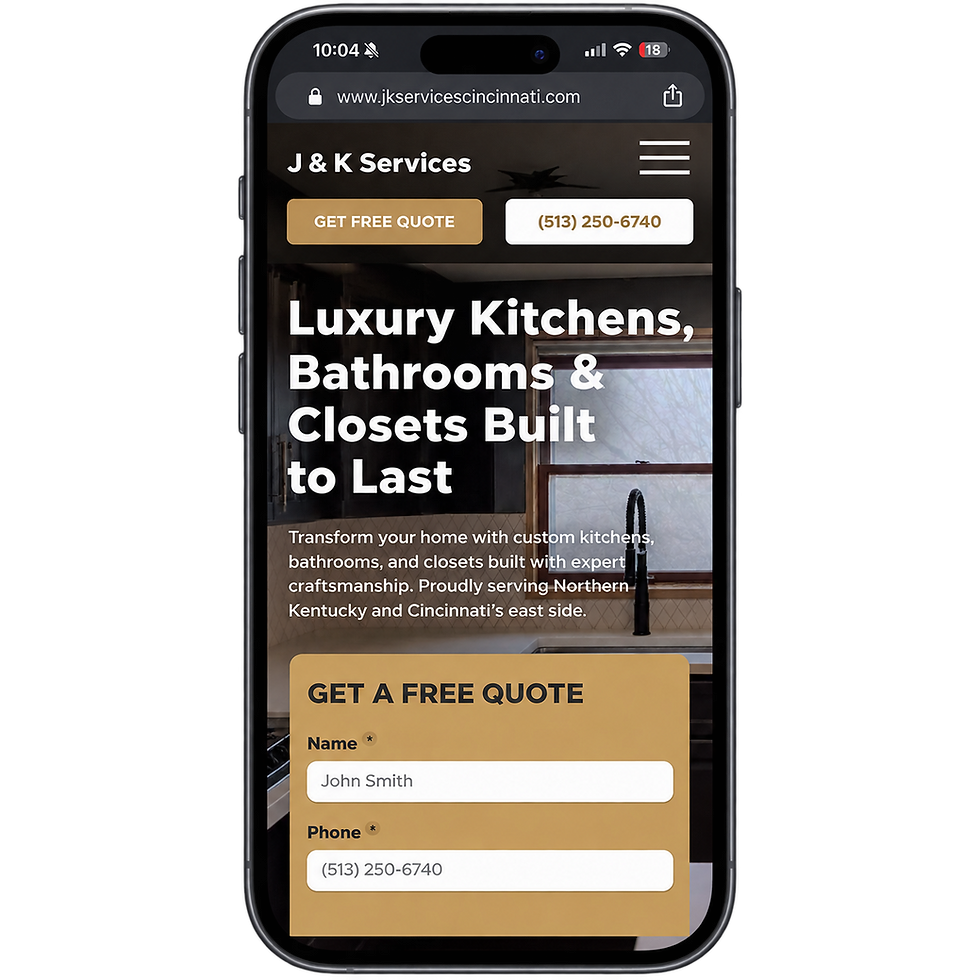
A contractor website needs to work extremely well on mobile.
Imagine someone's furnace stops working in January.
They grab their phone, search for an HVAC company, and open your website.
If they encounter tiny text, slow-loading images, broken buttons, confusing menus, or a phone number they can't easily tap, you've introduced friction at the exact moment they're trying to hire someone.
Test your own website from your phone.
Try to:
-
Figure out what the company does.
-
Find a service.
-
View previous work.
-
Read reviews.
-
Call the company.
-
Submit the contact form.
If any of those are difficult for you, they're probably difficult for your customers too.
Website Speed Matters
You don't need to obsess over achieving a perfect score on every website performance tool.
But your website should feel fast and responsive.
One of the biggest problems on contractor websites is often images.
Contractors naturally have tons of project photos, but uploading enormous original files directly from a phone or camera can add unnecessary weight to a page.
Before uploading images:
-
Resize them appropriately
-
Compress large files
-
Use modern image formats when practical
-
Avoid loading enormous galleries unnecessarily
-
Don't use video backgrounds everywhere just because you can
The goal isn't to impress a speed-testing tool.
The goal is to avoid making a potential customer wait unnecessarily for your website.
Your Contractor Website Should Be Built With Google in Mind
A good contractor website is built for homeowners first, but search engines still need to understand it.
Google should be able to determine:
Who your company is.
What you do.
Where you operate.
What each page is about.
That means your website should have a logical structure.
For example:
Homepage
↓
Roofing Services
→ Roof Replacement
→ Roof Repair
→ Metal Roofing
↓
Locations
→ Cincinnati
→ Mason
→ West Chester
Pages should also use clear headings, descriptive title tags, useful content, sensible URLs, internal links, and descriptive image alt text where appropriate.
What you shouldn't do is write unnatural paragraphs like:
"Looking for the best Cincinnati roofing contractor in Cincinnati Ohio? Our Cincinnati roofing company provides Cincinnati roofing services to Cincinnati homeowners..."
Nobody wants to read that.
Write for humans while making the subject of the page obvious.
What About City Pages?
City pages can make sense for contractors serving multiple important markets, but they shouldn't simply be copies of one another.
Suppose you serve:
Cincinnati
Mason
West Chester
Loveland
Milford
Creating useful pages for those markets can help explain where you work and provide locally relevant information.
But don't create one page and swap the city name 25 times.
Where possible, make location pages genuinely useful by including things like:
-
Services you provide in that area
-
Projects completed nearby
-
Reviews from customers in the area
-
Specific communities/neighborhoods served
-
Relevant information about working in that market
-
Original photos
-
Appropriate contact information
If you have nothing unique or useful to say about a location, ask yourself whether it really needs its own page.
Your Website and Google Business Profile Work Together
A contractor doesn't need to choose between having a website and having a Google Business Profile.
They serve different purposes and can complement each other.
Someone may discover your business through Google Maps, see your reviews and photos, and then click through to your website to investigate further.
On your website they can:
-
Explore individual services
-
View larger project galleries
-
Learn about your company
-
Read more reviews
-
Understand your process
-
Submit an estimate request
Think of your Google Business Profile as one important part of your overall online presence, not a replacement for everything else.
Don't Have a Google Business Profile Yet?
I've created a free step-by-step video showing contractors what a Google Business Profile is, why it matters, and how to set one up themselves.
If you fill out the form below, we will send it over to you.
Your Website Needs to Turn Visitors Into Leads
Getting 1,000 website visitors doesn't mean much to your business if none of them contact you.
That's where conversion comes in.
You want to eliminate unnecessary friction between:
“I'm interested.”
and:
“I want an estimate.”
1. Make Your Phone Number Easy to Find
Especially on mobile, make it clickable.
Use Clear CTAs
Instead of vague buttons like:
Learn More
use:
Request an Estimate
Call Now
Tell Us About Your Project
when that's the action you actually want.
Keep Forms Reasonable
You probably don't need 15 questions just to start a conversation.
For many contractors, an initial form can be as simple as:
Name
Phone
Service Needed
Project Details
Ask for additional information later if you need it.
Give Visitors Multiple Opportunities to Convert
You don't need a button after every paragraph.
But someone shouldn't have to scroll all the way back to the top after deciding they want to contact you.
Put CTAs at natural decision points throughout important pages.
Common Contractor Website Mistakes
Before we finish, here are some mistakes worth checking your own website for.
Using Too Many Stock Photos
Use your actual work whenever possible.
Having One Tiny Services Section
Give important services enough information to stand on their own.
Hiding Contact Information
Make contacting you obvious.
Ignoring Mobile
Actually use your website from a phone.
Writing for Google Instead of Homeowners
Keywords shouldn't make your copy sound ridiculous.
Copying the Same City Page Over and Over
Create pages with actual value.
Making Claims Without Evidence
Show proof instead of declaring yourself “the best.”
Overdesigning the Website
Animations and effects should support the experience—not become the experience.
Never Updating Anything
Your company changes. Your website should change with it.
Can You Build a Contractor Website Yourself?
Absolutely.
Modern website builders have made it easier than ever to create a basic website without knowing how to code.
DIY can make sense if:
-
You're just starting
-
Your budget is extremely limited
-
Your needs are simple
-
You have the time to learn
-
You're willing to maintain it
Hiring someone starts making more sense when your business is established, your time is better spent elsewhere, or you need a website that goes beyond simply existing online.
The real question isn't:
“Can I build my own website?”
It's:
“Is building my own website the best use of my time?”
There's no universally correct answer.
Don't Forget About Your Website After It Launches
A website isn't something you build once and never touch again.
Periodically check:
Contact Forms
Submit one yourself and make sure you actually receive it.
Phone Numbers
Make sure they're correct and clickable.
Business Information
Update hours, employees, services, service areas, and other details when they change.
Project Photos
Replace older work with stronger recent projects.
Reviews
Continue adding legitimate customer proof where appropriate.
Software & Security
Keep the platform and integrations maintained.
Analytics
Understand whether people are actually visiting and contacting you.
Google Search Console
Monitor how Google is discovering and displaying your website.
Some of this is boring.
But maintaining the asset is part of having one.
Contractor Website Checklist
Basics
☐ Is it immediately clear what you do?
☐ Is it clear where you work?
☐ Is your contact information correct?
Services
☐ Are your main services easy to find?
☐ Do important services have dedicated pages?
☐ Do those pages answer real homeowner questions?
Trust
☐ Are you showing real reviews?
☐ Are you showing real projects?
☐ Can visitors learn about your company?
☐ Are legitimate credentials displayed where relevant?
Conversion
☐ Is your phone number easy to find?
☐ Is there an obvious estimate/contact button?
☐ Is your form easy to complete?
Mobile
☐ Is text easy to read?
☐ Are buttons easy to tap?
☐ Does navigation work properly?
☐ Can someone easily call you?
SEO
☐ Does every important page have a clear topic?
☐ Are title tags and headings descriptive?
☐ Do relevant pages link to one another?
☐ Is important content indexable?
☐ Is Google Search Console connected?
Performance
☐ Are your images properly sized/compressed?
☐ Does the site feel fast on mobile?
☐ Have you removed unnecessary effects or scripts?
Key Takeaways
You don't need the fanciest contractor website in your market.
You need a website that makes it obvious what you do, where you work, why someone should trust you, and what they should do next.
Show real work. Build useful service pages. Make the website easy to use on a phone. Think about Google from the beginning. Remove unnecessary friction from contacting you.
And above everything else:
Build your website for the homeowner who's deciding whether or not to call you.
Written by Braden Wilking
Braden Wilking is the founder of Wilks Marketing. After spending years around contractors and working for small landscaping businesses, he saw how many great tradespeople struggled to use the internet to grow. Today, he works directly with home service businesses on their websites, local SEO, and online presence.
Written by Braden Wilking
Braden Wilking is the founder of Wilks Marketing. After spending years around contractors and working for small landscaping businesses, he saw how many great tradespeople struggled to use the internet to grow. Today, he works directly with home service businesses on their websites, local SEO, and online presence.
Want Help Improving Your Local Visibility?
You don't have to figure all of this out yourself. Tell us about your business and what's currently holding you back. We'll see if Wilks Marketing is a good fit to help.
No Long-Term Contracts
100% Satisfaction
Guarantee
Fast Turnaround
Times
Secure & Reliable
Websites
Want Help Improving Your Local Visibility?
You don't have to figure all of this out yourself. Tell us about your business, where you're trying to grow, and what's currently holding you back. We'll see if Wilks Marketing is a good fit to help.
No Long-Term Contracts
100% Satisfaction
Guarantee
Fast Turnaround
Times
Secure & Reliable
Websites
Want Help Improving Your Local Visibility?
You don't have to figure all of this out yourself. Tell us about your business, where you're trying to grow, and what's currently holding you back. We'll see if Wilks Marketing is a good fit to help.
No Long-Term Contracts
100% Satisfaction
Guarantee
Fast Turnaround
Times
Secure & Reliable
Websites